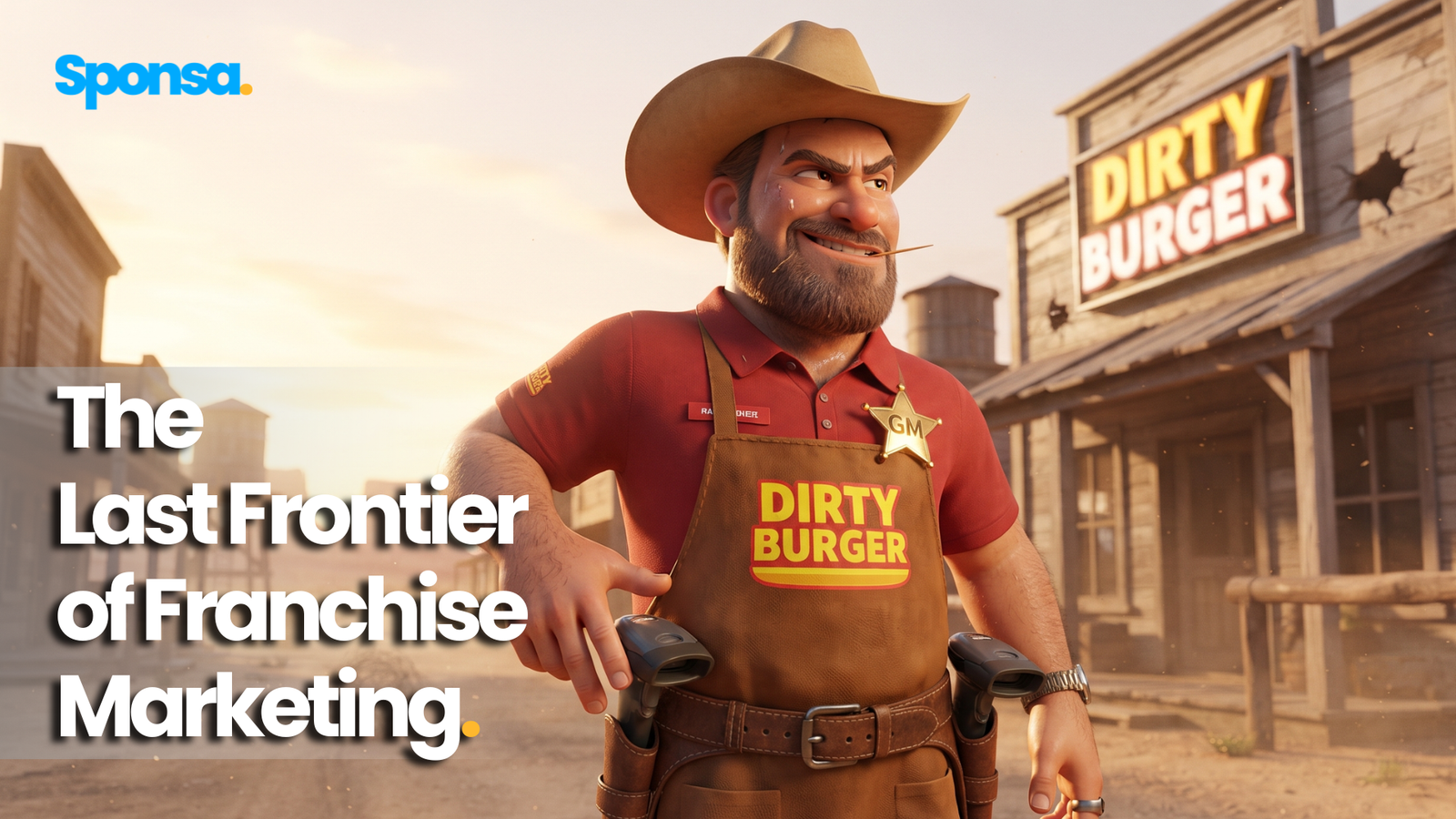
Community Sponsorships Are the Last Frontier of Franchise Marketing.
Community Sponsorships Are the Last Frontier of Franchise Marketing
Every other channel got standardized, measured, and rolled out the same way across every location. This one still runs on instinct, email, and a handshake - and it's costing brands more than they can see.
When you picture the Wild West, you know exactly what you see. Dirt roads. A one-street town of weathered wooden buildings. A tumbleweed drifting past. No rules, no standards, no guidelines, just a single sheriff trying to keep the peace, making every call himself.
It's not so different from how community sponsorships work in franchise marketing today.
Every location is its own little frontier town. The local GM is the sheriff - the only law for miles. A coach rides in asking to sponsor a banner, a school for a fundraiser, a team for jerseys. The GM makes the call right there based on gut feel. A handshake, a check, a sign up by the week after. No rulebook. No note back to headquarters. Almost no record of it ever happening.
Now multiply that by one hundred, two hundred, five hundred locations, and you start to see the problem. Five hundred sheriffs. Five hundred handshakes a week. Nobody is holding a map with a legend.
Which is strange, when you think about it because every other channel in franchise marketing got civilized a long time ago.
Everything else already got civilized
Look at how much of franchise marketing has been figured out.
Media buying has approved vendors, locked-down creative, and a measurement stack that ties spend to outcomes. Brands have guidelines documented with a sign-off chain, so the logo looks the same in Boise as it does in Boca. Loyalty runs on a platform with dashboards and attribution. The LTO calendar is planned nine months out, corporate-down, and executed in lockstep across the system. Even local search, listings, reviews, store pages, and digital out-of-home billboards run through software now, with reporting and someone whose actual job it is to manage it.
Every one of those channels went through the same journey. It started messy, lawless and inconsistent. Then someone decided the chaos was costing too much, built a system, set the standards, and rolled it out so every location did it the same way. Standardize, centralize, measure, repeat.
That journey, imposing consistency and visibility across hundreds of locations, is basically the entire project of modern franchise marketing. It's the whole job.
So it's worth asking why one channel got left out of it entirely.
The last frontier of marketing
Here's the reframe most brands never make: the last frontier in franchise marketing isn't some new technology. It's the oldest channel of all - still run on gut feel and a handshake.
Community sponsorships. Youth teams, school fundraisers, local causes, the banner at the ballfield. It's one of the largest pools of local spend a franchise system deploys - and it's the only one with no map, no rules, and no record.
Walk into any franchise brand's world and you'll find the same picture. At headquarters, a marketing director watches sponsorship requests trickle in from across markets - dozens of them, scattered across locations, in every format imaginable, with no clean way to tell which ones got a yes and which didn't. But that's only the fraction that ever reaches HQ. Out at the store level, each GM is working through their own stack of dozens a month, and making the calls themselves, one handshake at a time.
In the last frontier of franchise marketing, the GM is the sheriff. The marketing director is back at HQ with a spyglass, catching glimpses of a picture they can't actually see.
And the deals themselves have no structure. There's no standard package, every ask is a custom, one-off. There's no approval flow, the GM says yes or no on instinct. There's no central record, the spreadsheet that's supposed to track it all was last updated months ago, if it exists at all.
The lawlessness shows up everywhere you look:
No map. Nobody can see the whole territory. Which locations are sponsoring which teams, leagues, and causes. Where the brand actually shows up across its own communities is anyone's guess. And what the brand is getting back for the money, is a bigger guess still.
No sheriff. There's no consistent approval or governance. Whether a $500 check goes out is entirely up to whoever happens to be running the store, written off as charity or comps.
No standards. Signs are different, sign graphics vary in quality, brand name usage varies with no standardization or way to verify.
No records. Money leaves, a sign goes up, and there's no artifact that it ever happened - no receipt, no report, no line in a system. Instead the chase for proof of activation begins, opening another layer of lawlessness.
Now put a number on it. Multi-location brands are spending an estimated $2.25+ to deploy every $1 of value into local sponsorships, because the process is so manual and fragmented. And this isn't a niche expense. Brands pour billions into sponsorships every year, and a large share flows into exactly this kind of local, community-level partnership, with none of the discipline they bring to every other line on the budget.
That's not a rounding error. That's a real channel, moving real money, running completely wild.
Why this channel never got structured
Here's the part that matters, though: this didn't happen because brands are careless. Community sponsorships resisted structure for reasons that are actually pretty understandable, and until you see them, the chaos looks like a natural result and negligence instead of history.
It started as charity, not marketing - and it's still treated that way. Youth sports leagues, school programs, local causes: these are almost all non-profit, volunteer-run community organizations. And historically they've never come to a brand with a media pitch. They come the way you'd approach a neighbor. "We run this program, we could use a little support, and we'll put your name on a banner to say thanks." That charitable framing set the terms for both sides. The brand receives it as goodwill - a donation, a nice thing to do for the neighborhood - not a channel to be optimized. And nobody builds approval flows and attribution dashboards around what they think of as charity. So the money goes out the door as a good deed. And good deeds don't get tracked like media. Sponsorships to community organizations like youth sports teams are not goodwill, it’s a strategic partnership with families in a highly engaging environment that brings repeated exposure and trust building unique to other channels.
It's always been local and ad hoc. These asks come in at the store level, one at a time. Sometimes it's a familiar face like a coach, a regular customer, and sometimes it's just whoever walks through the door with a flyer. Either way, they've traditionally been handled right there, on the spot, case by case. Each one gets a quick decision and then disappears into the day. Nothing rolls up. Nothing gets logged as part of something bigger, because at the store level, it never looked like a channel. It looked like a stack of small, unrelated asks from the neighborhood. So it stayed that way and was written off as charity.
The return was always hard to prove. Even brands that wanted to treat this like a real channel hit a wall: how do you tie a banner at a Saturday ballgame to an actual business result? There was never any infrastructure or easy way to connect that spend to foot traffic, sales, or brand lift - and rolling out custom systems with QR codes, location by location, was more effort than the individual dollars seemed to justify. So the discipline brands apply to measurable channels never got applied here. And what you can't measure, you don't manage.
And the tools never existed. Even the brands that wanted structure had nowhere to get it. Sponsorship platforms are built for the property side - they help teams and venues manage their inventory, not help a brand govern its own spend. Local marketing software does ads, listings, and reviews, not community partnerships. There was simply no category, and no system, built for what franchise brands were actually doing: standardizing this spend, governing it, and tying it back to real goals. So the frontier stayed open, because nobody ever built the roads.
None of those reasons are wrong. But none of them are reasons to stay wild forever — they're just the reasons the frontier lasted this long.
What settling the frontier looks like
Here's the thing about frontiers: they don't stay lawless. Eventually someone shows up, looks at the dirt roads, tumbleweeds blowing through and desolate surrounding areas and sees the paradise that can be built there.
Settling this one doesn't mean spending more or caring less about the community. It means giving the channel the same four things every other channel already has:
Standardize it. Set the packages and terms once. Locations pick from approved options instead of inventing a new deal every time.
Centralize it. One place for every request to land and to activate each sponsorship, so each one across every location is visible from a single view.
Govern it. A real approval flow, so spend is intentional, on-brand, and on-policy - the sheriff finally has a rulebook.
Measure it. Track it like any other channel: engagement, redemption, performance by sport, market, and offer. Turn the long pause into an answer.
That's the gap Sponsa was built to close. Sponsa is the operating system franchise brands use to centralize, standardize, and measure local community partnerships - turning fragmented, invisible spend into a managed, performance-driven growth channel. It's not another performance tool bolted onto the ad stack. It's the infrastructure layer for spend that's already happening, chaotically, right now. It doesn't ask brands to start a new line item. It brings a system to the one they already have and can't see.
What this means if you run franchise marketing
If you own marketing across a franchise system, the uncomfortable part is this: the channel you can't see is still spending your money and shaping your brand in every neighborhood you operate in - every single week. Community sponsorships are one of the most effective tools for franchise locations to build trust, loyalty and traffic.
Structuring it isn't about clamping down or spending more. It's about making the spend you're already making visible, consistent, and accountable. And there's an edge in being early. The brands that systematize community partnerships now are the ones who turn a system-wide blind spot into a measurable growth channel, while their competitors are still squinting at a spreadsheet from last year.
You don't need a platform to start seeing it clearly. You need five questions answered on Monday morning:
How many sponsorship requests do our locations get in a month?
Who approves them and against what standard?
Where's the record of what we've committed to?
What did we actually spend last year, and what did we get for it?
How are we managing the process end-to-end today?
If those answers come back fuzzy, you've found your frontier.
The last town on the map
Every frontier gets settled eventually. The messy, personal, un-trackable channels always get their roads and their system of record in the end, because the cost of leaving them wild finally outgrows the discomfort of civilizing them. Especially when franchise brands need to lean on community more and more as a marketing channel.
Community sponsorships are the last open territory in franchise marketing. Billions moving on handshakes, one town at a time, with nobody holding the map. The brands that draw that map first won't just clean up the chaos. They'll own a channel everyone else still thinks is impossible to run.
The sheriff did his best. But it's time the frontier and the sheriff got a system.
Curious what that system actually looks like? That's exactly what we're building at Sponsa - see what community sponsorships can look like.