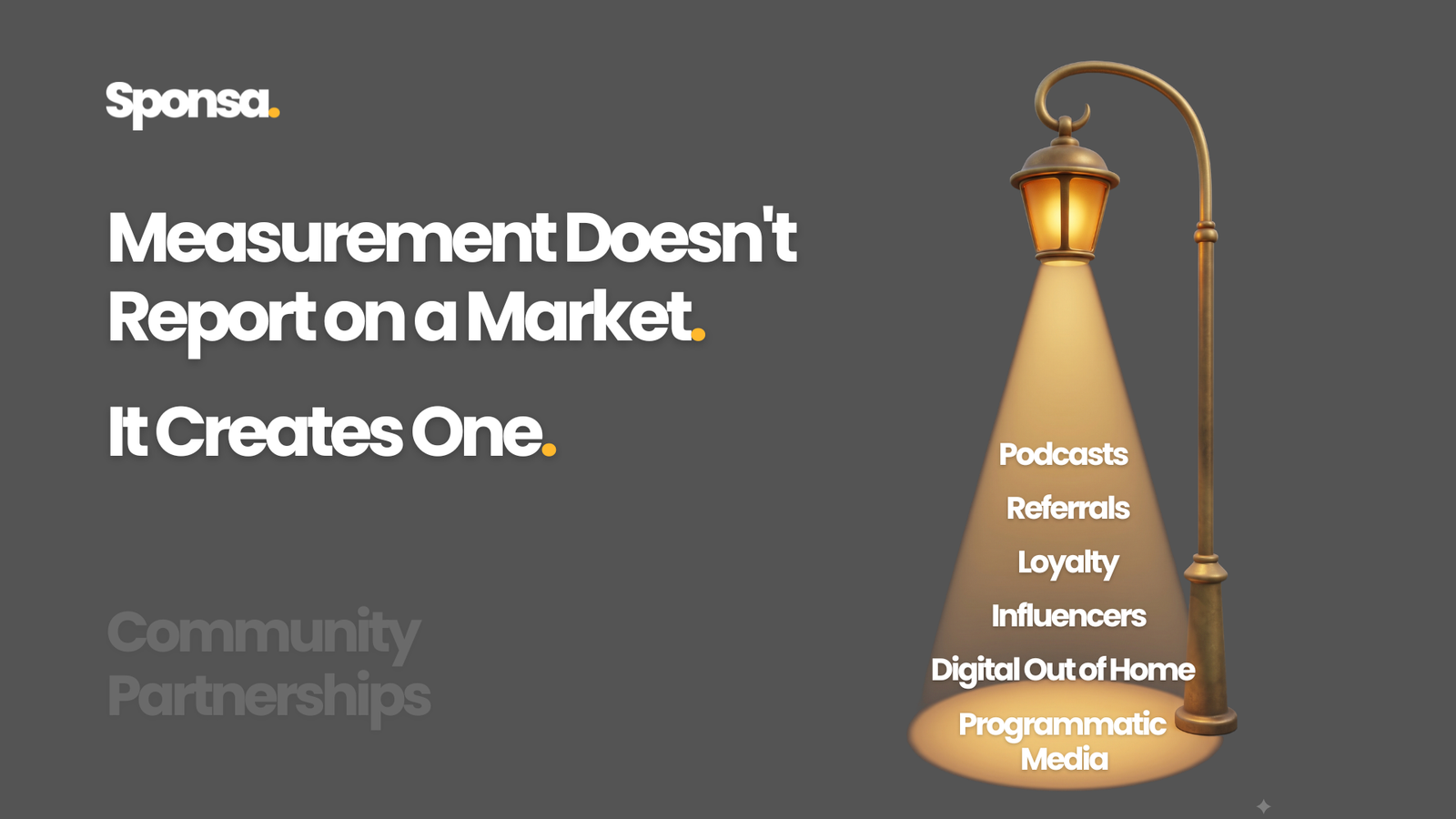
Measurement Doesn't Report on a Market. It Creates One.
Measurement Doesn't Just Report on a Market. It Creates One.
Five times in fifteen years, a fragmented offline channel got an infrastructure layer, and the money didn't just grow, it reclassified. Local community partnerships are next.
There's an old story about a man on his hands and knees under a streetlight, searching for his keys. A stranger stops to help, and after a while asks where he actually dropped them. "Over there," the man says, pointing into the dark. "So why are you looking here?" "Because the light's better."
That's a joke about a drunk. It's also, uncomfortably, how a lot of marketing budgets get allocated. Not because marketers are careless. They optimize constantly, chasing every point of efficiency they can measure. But money doesn't always find its way to the channels that work best. It finds its way to the channels you can see: the ones with dashboards, attribution, and a clean number at the end of the quarter. The channels that can prove themselves win the budget, and the ones that can't make do with whatever is left. Researchers even have a name for this pull. They call it the streetlight effect, and it quietly shapes where billions of dollars go.
For fifteen years, the same story has played out in channel after channel. Something messy and offline and impossible to measure gets an infrastructure layer: software, standardized inventory, real attribution. And the moment the light comes on, the money doesn't just grow. It changes character. Budgets migrate. Spend gets reclassified. A line item that used to be an afterthought becomes a category.
It's happened to web display, to retail media, to billboards, to influencers, to podcasts.
There's one big channel left sitting in the dark. And everything about the pattern says it's next.
Money moves toward the light
The streetlight effect has a serious pedigree. A team writing in the Journal of Marketing described it as an overreliance on data that's easy to access and measure, and named the gap in measurability between digital and offline media as a direct cause of overspending on the trackable stuff. Put plainly: when one channel can prove its impact and another can't, the provable one wins the budget. Not because it works better, but because it argues better in a meeting.
There's an older, sharper version of the same idea. In 1971 the sociologist Daniel Yankelovich described what he called the McNamara fallacy, named for the Defense Secretary who ran the Vietnam War on body counts. It has four steps. Measure what's easy to measure. Disregard what isn't. Presume that what can't be measured isn't important. Finally, conclude that what can't be measured doesn't exist.
That last step is the dangerous one, because it's exactly what happens to an unmeasured marketing channel. First it goes unmeasured. Then it gets treated as unimportant. Then, eventually, it stops being seen as marketing at all, and gets filed under something softer, like "giving back."
Hold onto that. It's the whole trap.
You can watch it happen right now. Brands keep pouring money into Meta even as the case for it gets harder to defend. In 2025, Meta's ad revenue grew 22% to roughly $195 billion, and Mark Zuckerberg told investors that ads would be, by far, the biggest driver of the company's growth. Over that same stretch, the cost of reaching people on the platform climbed about 20%, and got more expensive in every single industry. The average cost per lead rose 21%. Audiences, meanwhile, are checking out: roughly two-thirds of people admit to banner blindness, and 91% say ads feel more intrusive than they did a couple of years ago. Rising costs, fatigued audiences, and the spend goes up anyway. Why? Because whatever else is true, you can measure it. There's a number at the end of the quarter. The light is on, so the money stays.
That's the pull. Here's the mechanism it sets off.
When a fragmented, offline channel finally gets an infrastructure layer (standardized inventory, unified measurement, software to buy through), three things happen, in order, every single time.
First, friction collapses. Buyers stop running tiny experimental tests and start writing standardized, recurring line items.
Second, budgets migrate. Money flows out of older, harder-to-track channels and into the one that can finally show its work.
Third, the channel captures adjacent spend. Once it's connected to software, it starts absorbing budgets from entirely different functions, money that was never "supposed" to go there.
Underneath all three is the same engine: measurement is what makes a channel legible to serious money. A brand can't deploy millions by hand. An operator can't run community spend across forty locations off a spreadsheet. Software is the permission slip that lets real capital move. The light doesn't just help you find the keys. It's what makes anyone willing to spend the time looking.
It has already happened five times
The pattern isn't a theory. It's a rerun.
Web display, 2008 to 2014. Buying a banner ad used to mean emailing an insertion order to a publisher, negotiating a rate, and waiting days for the campaign to go live. Then real-time bidding and demand-side platforms turned it into software. Today programmatic accounts for roughly 91% of all US digital display buying. On the way, it swallowed budgets that used to belong to print, classifieds, and direct mail.
Billboards, 2015 on. This one matters, because outdoor is physical, the thing people always say can't be systematized. It ran on regional brokers, printed vinyl, and static leases with zero reporting. Then programmatic rails reached the screens. Vistar Media now processes around 30 billion bid requests a month. And listen to where the money comes from: among US marketers increasing their programmatic outdoor spend, 97% say it's being pulled from other digital channels. Physical didn't stop the pattern. It just waited its turn.
Retail media, 2012 on. This is the closest structural match to what I'm about to describe. For decades, brands paid retailers "trade dollars" for physical placement: endcaps, shelf space, circular features. Messy, relationship-driven, hard to attribute. Then retailers built ad platforms on top of their own shopper data, and brands started shifting those trade dollars into retail media for one stated reason above all others: the attribution is cleaner. The result is one of the fastest-growing ad businesses in history. Amazon's ad revenue hit $56 billion in 2024 and $69 billion in 2025. That's trade spend, offline and relationship-based, reclassified as measurable media.
Influencers, 2016 to 2022. Before the infrastructure, this was PayPal payouts, DMs, and screenshots of engagement. Then platforms brought discovery, contracts, payments, and attribution. The industry's own language for the shift says it all: it went from a speculative art to a measurable science. A category once treated as free product sent to cool people became a performance channel worth north of $32 billion a year.
Podcasts, 2018 on. And this is the one that should feel familiar to anyone who's ever sponsored a local team. Podcast advertising started as a literal handshake: a host reading your ad, a rate agreed over email, a promo code if you were lucky enough to track anything at all. It didn't scale, because handshakes don't. Then came dynamic ad insertion, programmatic buying, and shared measurement standards that let brands compare one show against another. A channel built entirely on trust and personal relationships became measurable, without losing the trust that made it work.
Five channels. Same three moves. Friction collapses, budgets migrate, adjacent spend gets captured. Every time.
The biggest channel nobody can see
Now look at where a franchise operator or regional brand spends to win a neighborhood.
Not the national ad fund. The local stuff. An operator spends money on local marketing of every kind, and a meaningful slice of it goes straight to the community: the banner at the Little League field, the logo on the back of the soccer jersey, the team they sponsor because the coach walked in and asked, because their own kid plays, and because they know, without being able to prove it, that showing up in the community is the most durable marketing they have.
They're right, by the way. This isn't charity dressed up as strategy. Showing up in the community builds trust and engagement in a way no ad can buy. A local operator usually lives in the market they serve, and it pays off where it counts: parents are far more likely to notice a brand backing their kid's team than one backing a pro franchise, and most say they'd rather buy from a business involved in their children's lives. The money works. Operators know it works. So it flows, quietly and constantly, on instinct.
And every dollar of it moves in the dark.
It isn't small, either. No one can give you an exact figure, which is the first clue something is broken. Triangulate from what we do know: US sports sponsorship runs close to $20 billion a year, the youth sports market alone is worth around $40 billion, and the overwhelming majority of local sponsorship dollars come from local businesses rather than national brands. The precise number is unknowable, because nothing exists to measure it. That, too, is the point.
Here's what "in the dark" actually looks like inside a multi-location operator.
The spend is scattered and unseen. Sometimes every location makes its own calls. More often, at a larger franchise group, every request funnels to a single person, a local marketing lead who becomes the clearing house for all of it. Either way, nobody has one view of what's being spent, where, or on what.
The inventory is fragmented. Every league, every team, every school is a one-off, with its own price, its own terms, its own contact. Nothing is standardized. Nothing is comparable.
The process is manual. It runs on emails, spreadsheets, and handshakes. Deals get approved by reply-all. Whatever tracking exists lives in a tab someone stopped updating in March.
And the requests never stop. This is the part that grinds people down. That one marketing lead, or the GM at a smaller group, sits buried under a constant pile of inbound asks from coaches, parents, booster clubs, and schools, evaluating and coordinating each one by hand with no easy way to know whether any of it worked. Every "will you sponsor us?" is a manual judgment call.
It's the same pre-infrastructure mess that came before programmatic, before retail media, before podcasts. A huge channel that everyone knows works, running on tools that can't measure any of it.
What happens when the light comes on
So apply the pattern. If local community partnerships get a real infrastructure layer, the fifteen-year rerun tells us exactly what happens.
Friction collapses. Operators stop approving one-off asks and start deploying standardized, renewable partnership budgets across every location, the way they already budget for every other input.
Budgets migrate. Dollars move out of low-visibility local tactics and into the one that can finally prove it drove foot traffic. Local co-op funds that go unspent every year, because nobody can justify them, suddenly have a home.
And the channel captures adjacent spend. Local event budgets, field-marketing stipends, promotional allowances, the community-relations line: all of it starts consolidating into one measurable place. The spend that got filed under "giving back" gets refiled under marketing, because now it can prove it belongs there.
Then something bigger happens, the part most people miss.
Measurement doesn't just change how brands buy. It changes what the other side is. Today a youth league is a requester, an applicant, emailing around asking local businesses for checks. In a measured market, that same league is inventory: an audience with real data and a real price, the way a website became programmatic inventory the moment it could be bought and measured through software. The league stops asking for donations and starts selling something worth buying.
That's the reclassification. Not just a bigger budget, but a new market, with two sides that can finally see each other.
The layer that doesn't exist yet
Every one of those five transformations needed someone to build the layer: the standardized inventory, the unified measurement, the rails to buy through. Nobody has built it for local community spend.
That's what Sponsa is building: the infrastructure that makes it possible. The operating system a franchise operator or brand uses to centralize, standardize, and measure local community partnerships across every location, turning an invisible, blind-spot spend into a managed growth channel. Not a new place to send checks, but the infrastructure that turns the light on.
The market isn't waiting for local community partnerships to become valuable. They're already valuable, and operators have known it for decades, which is why the money keeps flowing into the dark. It's waiting for someone to turn the light on. And every precedent we have says the moment measurement arrives, the spend that used to trickle out in checks becomes a budget line serious money can stand behind. The operators who build the muscle before that shift arrives will own their local markets when it does.
The keys were never lost. The light just hadn't reached them yet.