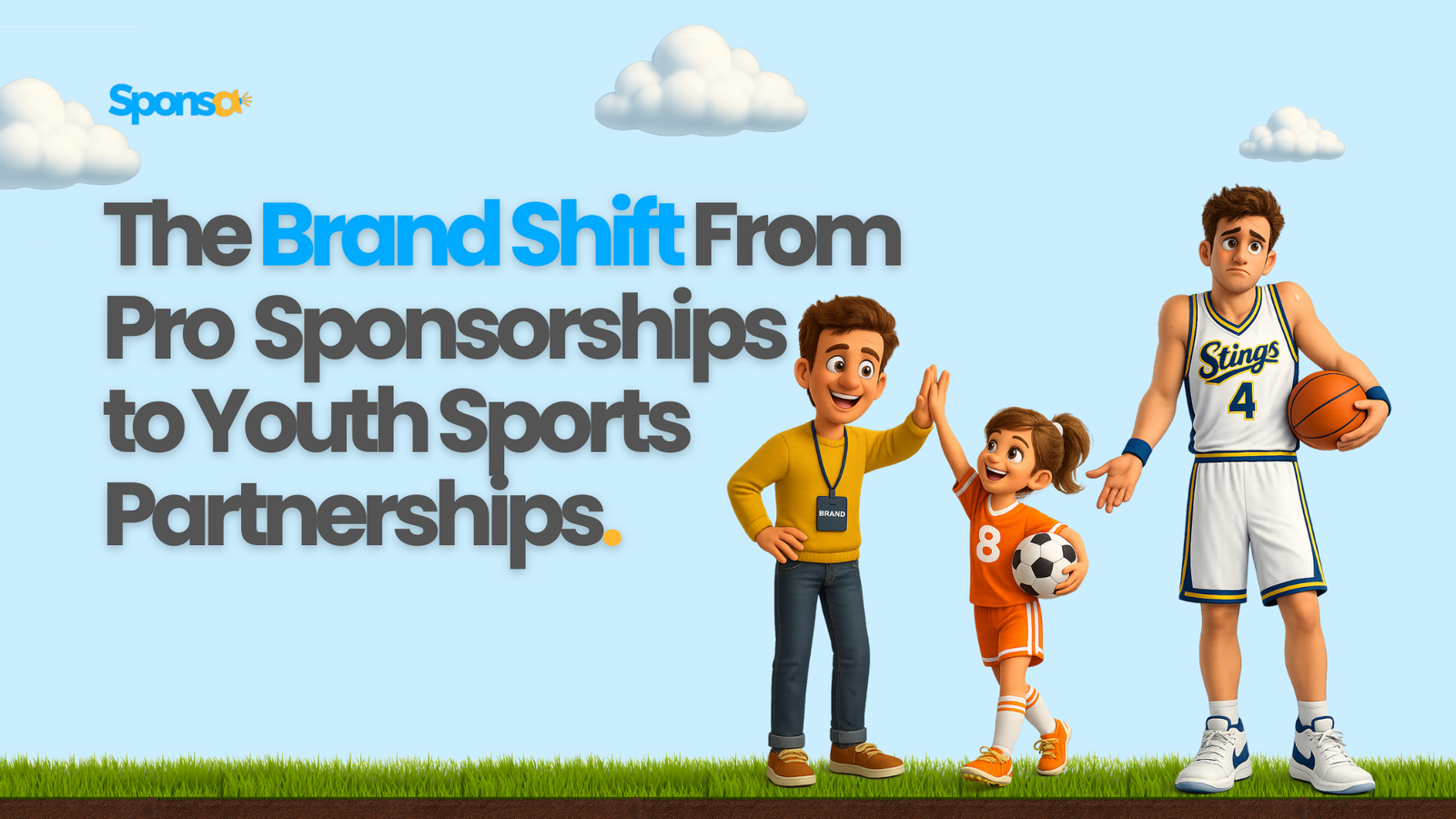
The Brand Shift From Pro Sponsorships to Youth Sports Partnerships.
How Sports Sponsorship Evolved — and Why It’s Changing Again
Sports sponsorship has been part of commerce and culture for centuries. Forms of sponsorship date back to ancient Greek and Roman times, but modern sports sponsorship began in the late 19th century when tobacco companies used baseball cards and team uniforms to promote their brands — including a Louisville-based company that sponsored the Louisville Colonels in the 1880s. The model evolved through milestones like Slazenger’s partnership with Wimbledon in 1902, early radio broadcast sponsorships in the 1920s (including Coca-Cola’s association with the 1928 Olympic Games), and, later, Mark McCormack’s landmark 1960 endorsement deal with Arnold Palmer, which helped define the commercial sponsorship model that dominated professional sports for decades.
For much of the 20th and early 21st centuries, sponsorship success was defined by scale. Brands paid premiums for jersey logos, naming rights, televised integrations, and athlete endorsements, measuring success largely through reach and impressions. The assumption was simple: more eyeballs equaled more value.
But the world has changed — and so have sponsorships.
Today’s consumers are more discerning, more values-driven, and far less impressed by visibility alone. They expect brands to stand for something, contribute meaningfully to communities, and demonstrate authenticity rather than simply buy attention. As a result, sponsorship is evolving from a transactional, logo-based model into a long-term, purpose-driven partnership strategy focused on trust, engagement, and measurable impact.
This shift has opened the door for one of the most powerful — and often overlooked — sponsorship opportunities available today: youth sports sponsorship.
The Macro Shift: From “Logo Slapping” to Purpose-Led Marketing
Authenticity Is Now a Requirement, Not a Bonus
Modern consumers — especially Millennials and Gen Z — expect brands to reflect their values. According to the Edelman Trust Barometer, people increasingly choose, avoid, or advocate for brands based on belief alignment and perceived social impact. Simply placing a logo in front of an audience is no longer enough to earn attention or loyalty.
This expectation has fundamentally changed how brands evaluate sponsorships. One-off, transactional deals that prioritize exposure over engagement often struggle to generate lasting value. In contrast, purpose-led partnerships that demonstrate genuine community involvement build stronger emotional connections and longer-term brand equity.
Youth sports naturally align with this shift. Supporting access to play, youth development, teamwork, and community health resonates deeply with families — and does so in a way that feels authentic rather than performative.
From Visibility to Storytelling
Sponsorship today is as much about storytelling as it is about visibility. Brands want partnerships that allow them to communicate who they are, what they stand for, and how they contribute beyond their products or services.
Youth sports sponsorship offers a uniquely powerful storytelling platform. It connects brands to meaningful moments: first games, personal growth, team camaraderie, perseverance, and community pride. These moments aren’t manufactured — they’re lived — and that authenticity is what makes the association so impactful.
Why Youth Sports Sponsorship Is Gaining Momentum
A Massive, Highly Engaged Audience
Youth sports are not a niche market. In the United States alone, more than 60 million children participate in organized youth sports each year, bringing parents, siblings, and extended families into the ecosystem (Campus Multimedia).
Youth sports is also a massive economic ecosystem. The Aspen Institute estimates U.S. families spend $30–$40 billion annually on children’s sports activities, and some industry analyses put the broader youth sports market at $60B+ when accounting for the full ecosystem beyond household spend.
What makes this audience especially valuable is not just its size, but its level of engagement. Youth sports are woven into family schedules and routines — practices during the week, games on weekends, tournaments, travel, and constant communication between teams and parents.
This creates repeated, meaningful touchpoints for brands that simply don’t exist in professional sports sponsorship.
Stronger Attention Than Professional Sports
A national study conducted by YouGov Sport and Priority Partnerships revealed a striking insight: parents pay 1.5 times more attention to brands that sponsor their child’s youth sports organization than to brands sponsoring professional sports teams they follow (Priority Partnerships Report / Youth Sports Business Report).
This attention advantage is critical. In a media environment saturated with advertising, attention has become one of the most valuable currencies — and youth sports sponsorship delivers it consistently.
Higher Purchase Intent and Brand Preference
Youth sports sponsorship doesn’t just capture attention — it influences behavior.
According to the same study:
68% of parents are more likely to purchase from a brand that sponsors their child’s youth sports organization than one that sponsors professional sports
80% of parents would choose a youth sports sponsor’s brand over a competitor when price and quality are equal
84% of parents report a positive perception of brands that sponsor youth sports
(Source: Youth Sports Business Report)
These are not soft awareness metrics — they are indicators of real purchasing behavior and long-term brand preference.
From Counting Impressions to Creating Impact
A New Definition of ROI
Traditional sponsorship models often emphasize vanity metrics such as impressions, reach, and logo exposure. While easy to quantify, these metrics don’t necessarily correlate with trust, loyalty, or conversion.
Modern brands are redefining ROI to include:
Brand favorability
Purchase intent
Emotional connection
Long-term customer loyalty
Youth sports sponsorship excels in this framework because it creates ongoing, repeated engagement over time — not just a single exposure during a broadcast or event.
When a brand supports a youth team throughout a season, families see that brand week after week. The brand becomes part of their lived experience, not an interruption to it.
“Fewer, Bigger, Better” Partnerships
Brands are also becoming more selective with sponsorship dollars. Rather than spreading budgets across dozens or hundreds of one-off activations, marketers are focusing on fewer, higher-value partnerships that deliver consistent impact and measurable outcomes.
Youth sports sponsorship fits this approach when executed correctly — especially when brands can activate at scale without increasing operational complexity.
Why Youth Sports Sponsorship Is Uniquely Powerful
Deeper Emotional Engagement
Professional sports fandom is often passionate, but it is largely observational. Youth sports participation, on the other hand, is deeply personal. Parents invest time, money, energy, and emotion into their child’s experience.
When a brand supports youth sports, it becomes associated with moments that matter — growth, achievement, resilience, and belonging. That emotional proximity dramatically increases recall, trust, and loyalty.
Community Integration
Youth sports sponsorships are embedded in local communities. Brands show up on jerseys, banners, registration platforms, and communications — not just once, but throughout the season.
This creates a sense of familiarity and goodwill that national advertising often struggles to replicate. Brands are no longer distant entities — they become part of the community fabric.
Values Alignment and Brand Safety
Youth sports promote universally positive values: teamwork, health, discipline, inclusion, and development. For brands seeking safe, values-aligned environments, youth sports offer an ideal platform — free from many of the reputational risks associated with elite professional sports.
Challenges in Youth Sports Sponsorship
Despite its advantages, youth sports sponsorship has historically been difficult to execute at scale.
The youth sports landscape is highly fragmented, made up of millions of independent leagues, clubs, teams, and facilities — many with limited resources and inconsistent infrastructure. Unlike professional sports leagues with centralized governance, youth sports lack a single, unified sponsorship marketplace.
This fragmentation creates several challenges for brands:
Managing large numbers of local relationships
Inconsistent sponsorship execution
Difficulty measuring performance and ROI
High administrative and operational burden
As a result, many brands have underinvested in youth sports — not because of lack of value, but because of lack of scalable infrastructure (Youth Sports Business Report).
Sponsa: The Operating System for Youth Sports Sponsorship
The challenge with youth sports sponsorship has never been the value — it has been the infrastructure.
For decades, brands have struggled to navigate a fragmented ecosystem made up of thousands of independent teams, leagues, clubs, and facilities. Discovery is manual. Activation is inconsistent. Measurement is limited. Inbound sponsorship requests pile up with no efficient way to evaluate, manage, or scale them. Even brands that want to invest meaningfully often find the process too complex and resource-intensive to sustain.
Sponsa was built to solve this — end to end.
Modernizing Youth Sports Sponsorship from Discovery to Measurement
Sponsa is not just a platform — it is the operating system for youth sports sponsorships, designed to centralize and modernize every stage of the partnership lifecycle.
Through Sponsa, brands can:
Discover vetted youth sports teams, leagues, clubs, and facilities that align with their values and target audience
Activate sponsorships at scale — locally, regionally, or nationally — through a single system
Manage all partnerships, assets, timelines, and communications in one centralized place
Track and measure performance beyond impressions, including engagement, participation, and brand impact
Manage inbound sponsorship requests efficiently, replacing scattered emails and ad-hoc asks with structured, actionable opportunities
What was once fragmented, manual, and inefficient becomes streamlined, measurable, and scalable.
Turning Fragmentation into a Strategic Advantage
Rather than forcing brands to choose between scale and authenticity, Sponsa enables both.
By centralizing youth sports organizations into one ecosystem, Sponsa allows brands to engage thousands of teams and families through a single partnership — while still delivering local relevance and community impact. Brands no longer need to manage hundreds of disconnected relationships or one-off activations to reach grassroots audiences.
This unlocks a fundamentally better sponsorship model:
Fewer internal resources required
Greater consistency in messaging and values alignment
Stronger ability to capitalize on partnerships over time
Sponsa helps brands move far beyond traditional logo placement by enabling sponsorships that are intentional, measurable, and purpose-driven.
Because Sponsa manages the full lifecycle — from discovery to reporting — brands can finally see how sponsorship dollars translate into real impact and real business value.
Built for the Way Modern Brands Operate
Today’s marketing teams demand efficiency, accountability, and data. Sponsa was built with those realities in mind.
By serving as the system of record for youth sports sponsorships, Sponsa allows brands to:
Replace spreadsheets, emails, and disconnected tools
Create repeatable, scalable sponsorship strategies
Turn inbound interest into organized, high-value opportunities
Optimize partnerships over time instead of starting from scratch each season
In short, Sponsa makes youth sports sponsorship work the way modern marketing works.
Conclusion: The Future of Sponsorship Is Community-First
Sports sponsorship has come a long way — from ancient patronage to tobacco cards, from stadium signage to global broadcast deals. Today, it is evolving once again.
As brands move away from one-off, transactional sponsorships and toward long-term, purpose-driven partnerships, youth sports have emerged as one of the most powerful platforms available.
With:
60+ million youth sports participants annually
Higher attention and purchase intent than professional sports sponsorship
Strong trust and positive sentiment among parents
Youth sports sponsorship delivers what modern brands need most: authentic engagement, measurable ROI, and meaningful community impact.
Sponsa exists to unlock that potential — helping brands move from impressions to impact, from transactions to partnerships, and from sponsorship to true community investment.
The future of sponsorship isn’t just about being seen.
It’s about showing up — and showing you care.
Email us at Oren@sponsa.ai to learn more about how Sponsa can work for your brand.