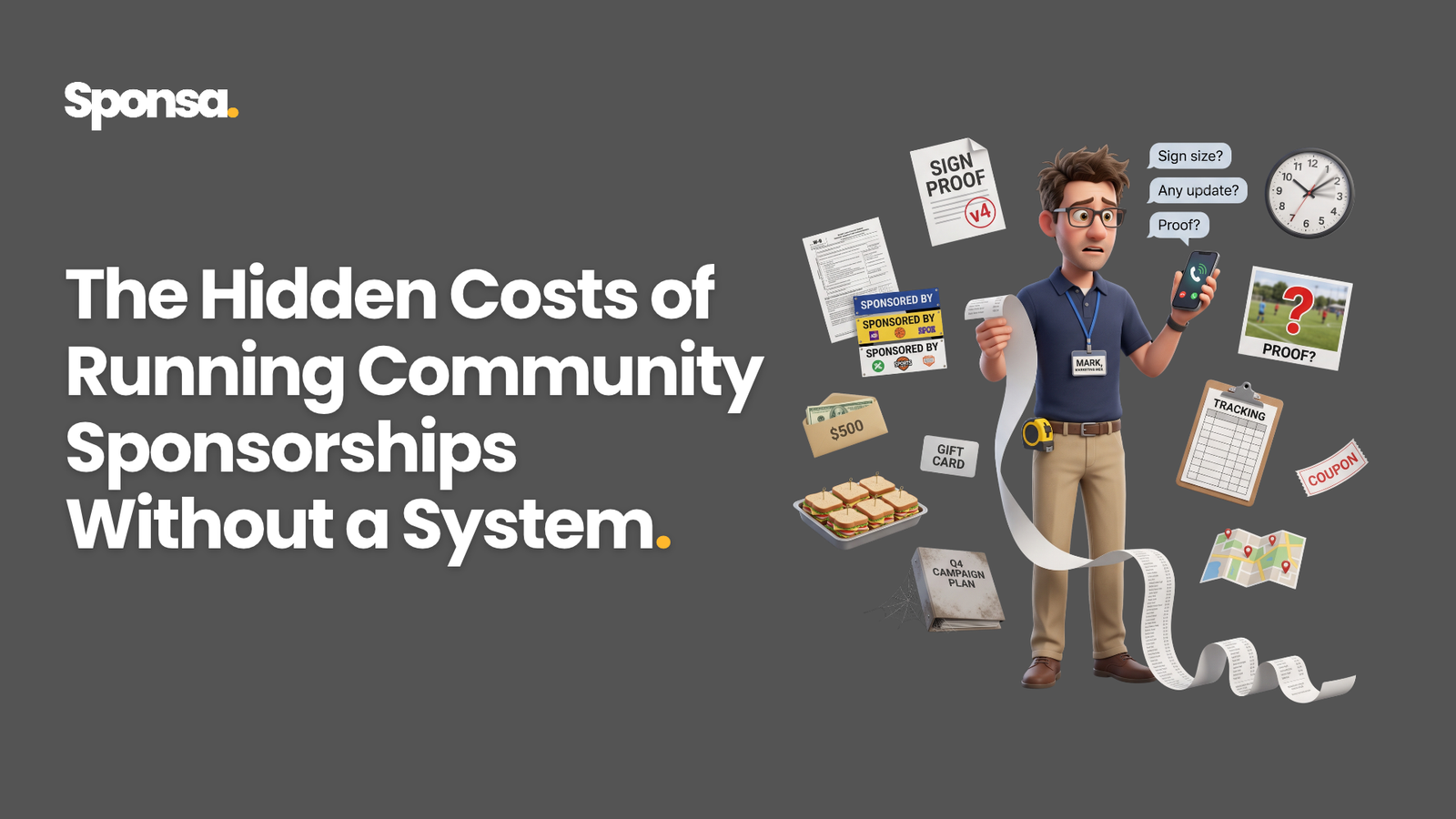
The Hidden Cost of Community Sponsorships Without a System.
The Hidden Cost of Community Sponsorships Without a System
For multi-unit operators, the money is the smallest part. The real cost is everything it takes to get a sponsorship out the door, and everything that does or doesn't happen after.
A coach walks into one of your stores and asks the GM about sponsoring their U10 soccer team. The GM likes the idea and passes it to your marketing manager, who emails the coach for details. Two days later the coach replies with a PDF that lists five sponsorship levels, none of which match what you did last season.
Then the back-and-forth starts. Where exactly would the sign go, the field fence or the concession area? Is the field theirs or does the town own it? How many home games, and what days? Do they have a team email list, and will they post about you? When does the season start, and when do they need everything by?
Meanwhile someone has to get creative made. Your designer needs the sign dimensions, which the coach has to find out, and the artwork goes back and forth until it fits. The money goes out and the sign gets made, then maybe hung.
Then your marketing manager starts following up. Did the sign go up? Where is it? Did the email go out to families? Three emails and two texts later, the coach sends a blurry photo from the sideline. That's the proof. Nobody knows if the team ever posted anything, and nobody knows if a single family walked into the store because of it.
Most multi-unit operators know exactly what they spend on community sponsorships, because it's on the books. What isn't on the books is what it takes to manage community sponsorships across multiple locations, and what actually comes back. That is where the real cost is.
You already know this matters. That's not the problem.
Ask any multi-unit operator whether being present in their communities is worth it and you'll get the same answer: of course it is. These are the families who live near your stores. Showing up for their kids is how a location stops being a logo on a building and becomes part of the town.
The problem is what a week actually looks like. You're managing staffing across every location, dealing with turnover, watching food and labor costs, handling equipment that breaks, running store-level P&Ls, and trying to open the next unit on schedule. Your marketing manager is somewhere in that same week, running brand campaigns, coordinating with the brand's co-op, handling promotions, managing digital, and getting a new store's opening ready.
Community partnerships sit on the list the whole time. Everyone agrees they matter. Nobody has the hours.
So it stays reactive. You say yes to the requests that come in, you do what you can, and you move on to the next fire. Not because you don't value it, but because nothing in the way it's currently run makes it possible to do more than that.
Why it runs this way
When you had one or two stores, this worked. You knew the coach, you knew the league, and a handshake was the whole system. The relationship was the process.
Community sponsorships have always run like this: requests come in locally, one at a time, each handled on its own terms. No standard package, no standard approval, no standard record. Operators didn't choose this. There just was never any infrastructure built for this kind of spend, while payroll, scheduling, inventory, POS, and even local SEO all got software years ago.
The trouble is what happens to that approach as you grow. It doesn't get a little harder. It multiplies.
Every location sits in its own town, with its own leagues, clubs, school districts, and park and rec department, each running on its own calendar. Every location has its own GM, with their own instincts about what to say yes to and their own appetite for dealing with this at all. Some bring in requests constantly. Others never mention it, which means your presence in a market has more to do with who runs the store than with how much the market matters to you. And every partnership has its own moving parts: different sign sizes at different fields, different season start dates, different deliverables the team either follows through on or doesn't.
Bringing in help doesn't solve it either. A marketing manager gives you someone to send it all to, but it's still the same manual work, now stacked on top of everything else they own, and often in communities they don't know. They're sitting at the office, not at the field in a town two hours away, so they're relying on a GM to tell them which leagues matter and a coach to tell them where the sign goes. An agency will handle campaigns, media, and creative, but sponsorships aren't a campaign. They're fifty small local relationships with paperwork, print jobs, and a volunteer coach on the other end, and no agency is set up to chase that. So it comes back in-house, to the person with the least room for it.
What makes this hard to see is that no single piece looks like a problem. One email thread is fine. One sign is fine. Nothing here is expensive on its own, and nothing shows up as a line item labeled "cost of managing sponsorships."
That's exactly why it goes unexamined. Add it up across every location and every season, and four real costs come into view.
1. Time and resources
Start with what comes in. Every request has to be read, replied to, and evaluated, including the ones you turn down. Is this team in a market where you need presence? How big is the roster, and how many families does it actually reach? Is what they're asking for worth it compared to the other three requests sitting in the inbox? Is there any budget left this season? That's real thinking time, repeated for every request, and most of it produces no sponsorship at all.
Then the ones you say yes to. Agreeing on terms. Collecting paperwork. Arranging payment. Getting creative made to whatever dimensions that particular field requires, which means asking the coach, waiting, and sending artwork back and forth until it fits. Coordinating with the team on when everything has to be there.
Then the chasing, which is the part nobody budgets for. Did the sign go up? Is it in the spot you agreed on, or behind the concession stand where nobody sees it? Did the email actually go out to families? Did they post about you, and did they use the right creative and the offer? Each of those is a text, then a follow-up text, then a call, to a volunteer coach who has a day job.
Volume is what turns this into a problem. Across a season, a 15-location group might field a hundred or more requests and run 40 or 50 partnerships. Count every hour spent reading, evaluating, replying, coordinating, and chasing, across the GMs, the marketing manager, and the owner, and it lands in the hundreds. That's the equivalent of months of full-time work on a program nobody thinks of as a workload. (Illustrative numbers. Run your own and see where you land.)
And when that much detail runs through inboxes and spreadsheets, things slip. The wrong artwork goes to print. A deadline passes. The same team gets promised a sponsorship by two different locations. A coach's email sits unanswered for weeks until they give up and find another sponsor, often a competitor down the street. None of it is carelessness. It's what happens when the process is manual and the person running it is also doing four other jobs.
2. Inconsistency
Without a set program, every location runs its own. One store gives $1,000 cash, another sends product to a fundraiser night, a third caters a team dinner, and a fourth says no to everyone because the GM doesn't want to deal with it. Same brand, four completely different answers.
The bigger problem is what it does to your brand on the ground. The creative is whatever someone had handy, so sizes, colors, and logo versions vary from field to field. The messaging varies too. One sign has an offer, another just has your name, and a third has a slogan someone wrote in an email. The team announcement is written by the coach with no input from you. Brand standards get enforced carefully inside the store and not at all on a fence in a town two hours away, which is exactly where local families are looking at you.
Teams notice too. Parents talk, coaches compare notes, and what one store did becomes what the next team expects.
3. Tracking and measurement
This is the one that keeps the channel from ever getting better. Community spend goes out with no goal attached to it and no way to tell what came back.
It’s not tied to outcomes. There's no offer to redeem, or there is one and nothing tracks it across partnerships cleanly, so nobody can say whether a partnership brought a single family into the store. When the owner asks what the community program returned last year, the honest answer is a number spent and a few photos.
You can't compare or optimize. Which markets performed? Which package size was worth it? What sports work better? Was the $1,000 club better than three $300 teams? Without that, next year's budget is set the same way as last year's: by habit, and by whoever asks.
And there's no record that survives your people. The relationship with a local league usually lives with the GM who said yes. When they leave, the contact, the history, what was promised, and when it renews leave with them. What's left is renewal out of habit, because nobody can show whether it worked.
4. Opportunity loss
Everything above adds up to the real cost: the program you're not running.
You're missing partnerships you never see. The teams that walk in aren't necessarily the ones you'd choose. A new store opens with no local partnership lined up for launch. A location with soft traffic gets no community presence because nobody asked there. A 400-player club two miles from one of your stores never hears from you, while a smaller team across town gets a yes because the coach knows the GM. Timing is left to chance too: requests arrive when teams need money, not when your stores need the traffic.
You're also not getting full value from the partnerships you do run. A youth sports team is a group of engaged local families who see each other several times a week, all season. Few channels give you that kind of attention and trust. But a manual program stops at the banner. No offer for the families, no email or social post introducing your store, no team night that brings everyone in, no follow-up at season's end.
And the largest loss is what your team isn't doing while all this is happening. The hours spent coordinating and chasing are hours not spent planning campaigns, supporting a store opening, building a promotion that drives traffic, reviewing what's working across locations, or deciding where the community budget should go next season based on results. Your marketing manager is doing admin on a channel that should be run strategically.
It isn't that community sponsorships cost too much. It's that running them by hand costs you the ability to run them well.
What changes when it runs on a system
None of this is a reason to spend less on your communities. It's a reason to stop running the program by hand.
A system does four things a manual process can't.
It makes the channel strategic and proactive instead of reactive. Instead of your presence being decided by whoever walks in, you decide which markets need a partner: the new store opening in March, the location with soft weekday traffic, the town where your competitor is already on the fence at the ball field. The partnership follows your business priorities.
It standardizes the offer. You set your terms once, and every location works from the same packages, the same deliverables, and the same brand-approved creative. Nobody negotiates from scratch, and no team gets a different deal depending on which store they walked into.
It takes the coordination off your team. Intake, evaluation, paperwork, creative production, fulfillment, payment, and proof collection are steps a process should handle, not people. Your marketing manager reviews and approves instead of chasing.
It makes the results visible. Every placement carries an offer that can be tracked, every partnership has proof of activation attached, and everything lives in one record that outlasts any single GM. Budgets and renewals become decisions based on what worked.
That's what Sponsa is built to do. Sponsa is the operating system multi-unit operators use to centralize, standardize, and measure local community partnerships across every location. Teams apply through a branded QR code or link. You approve from packages you've already set. Creative is produced to sign specs and a tracking code, then printed and delivered to the team. Team emails and posts to their families and are paid throughout the season once they complete activation tasks. Every redemption is tracked by team and by location, so you can see which partnerships bring families through your doors.
The spend doesn't change. What changes is how much of it you get back, and how little of your team's time it takes to run.
Community sponsorships aren't the problem
Supporting local teams is one of the best things a multi-unit operator can do. It puts your stores in front of the families who live nearby, in a setting where they're paying attention and trusting what they see. That's worth investing in.
The problem is running it on email, spreadsheets, and handshakes. That approach costs your team time, fragments your brand in the markets where it matters most, leaves you with no way to measure what worked, and takes your marketer away from the work that moves the business forward.
The operators who get the most out of their communities will be the ones who manage local partnerships like any other channel: with a process, a record, and results they can measure.
See how multi-unit brands run local community partnerships with Sponsa. Schedule your demo today.