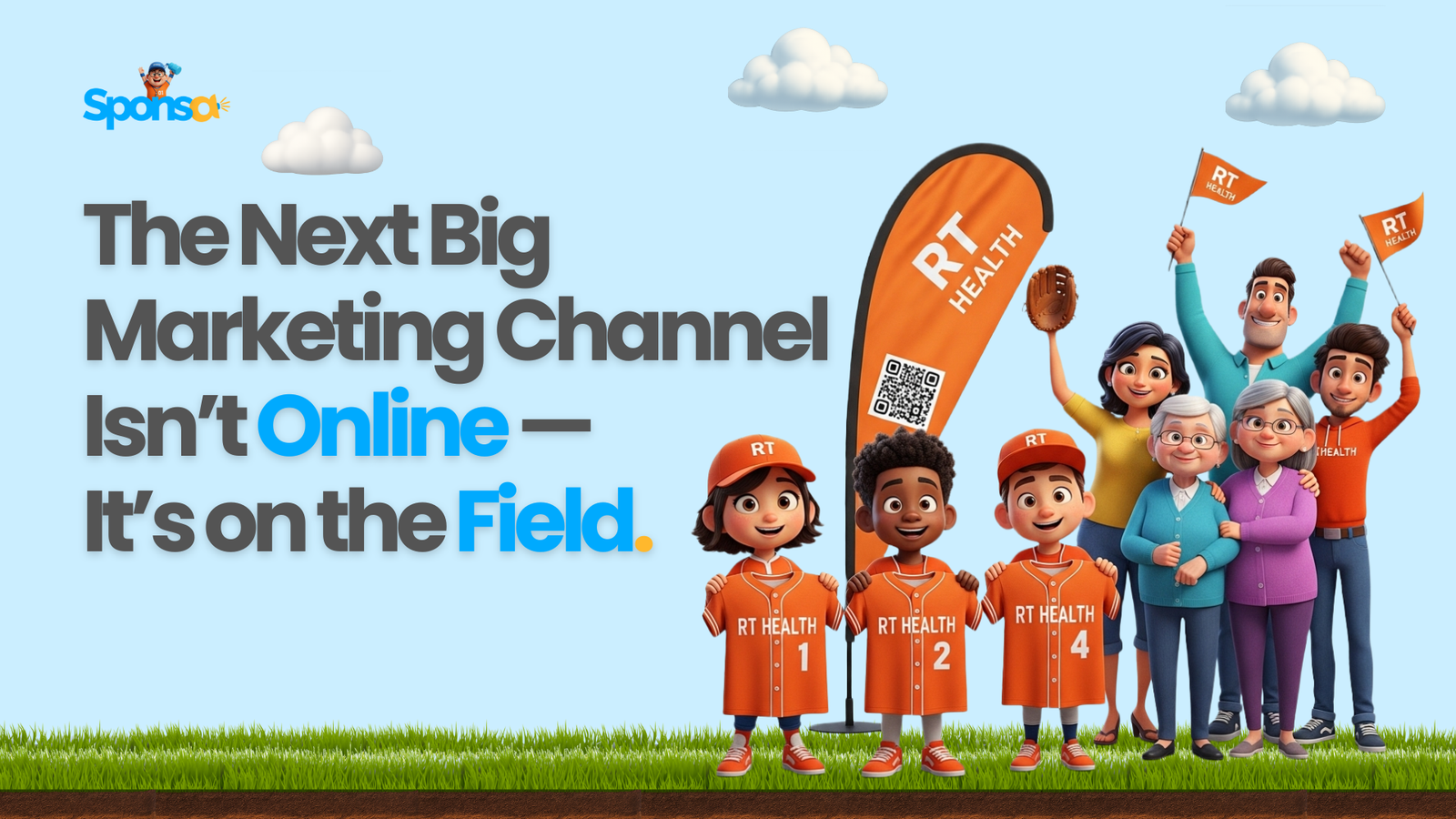
The Next Massive Marketing Channel Isn’t Online – It’s On The Field. .
The Next Massive Marketing Channel Isn't Online — It's On The Field.
The Game Plan:
Why big-league sponsorships have lost their emotional edge.
How youth sports partnerships build real trust and brand loyalty.
How new tools make local sponsorships measurable and ROI-driven.
How Sponsa helps brands scale purpose and performance together.
A Changing Game in Brand Marketing
Marketers today have more tools, channels, and data than ever before. From digital ads to influencer collaborations, content marketing to sponsorships, most brands run carefully coordinated omnichannel strategies designed to reach audiences across multiple touchpoints.
But here’s what many still overlook: not all impressions are equal. In an era where consumers crave authenticity and connection, where and how your brand shows up matters as much as how often it does. The 2024 Edelman Trust Barometer highlights broad trust challenges and rising expectations for brands to engage meaningfully with communities.
At the same time, the global sports sponsorship market is projected to grow from $63.1 billion (2021) to $109.1 billion by 2030, according to PwC. Yet a relatively small portion of that investment flows to youth and grassroots sports — where the emotional connection and local visibility are most powerful.
“While brands spend billions to reach people through screens, the most genuine way to connect may still be at the local field, rink, or court.”
When Big-League Sponsorships Lose Their Emotional Edge
Professional sports sponsorships still look glamorous — stadium signage, jersey patches, national TV integrations — but their emotional impact is fading.
NFL sponsorship revenue reached $2.49 billion for the 2024 season, underscoring the scale but also the saturation of brand messages (SportsPro, 2025).
NBA jersey patch deals are now worth a combined $285.8 million league-wide for 2024–25, averaging roughly $10.6 million per team (GlobalData).
That spending buys awareness but rarely trust. Fans increasingly view these placements as background noise. And according to Edelman, 64% of consumers believe brands “say they care about community but rarely show it.”
Big-league sponsorships deliver exposure, not empathy. They generate impressions, not relationships. In a landscape where meaning matters, youth sports offer something pro sports can’t: authentic proximity to real life.
Why Youth Sports Sponsorships Belong in the Modern Marketing Mix
For years, youth sports sponsorships have been treated as community outreach. In reality, they function as a powerful, high-engagement marketing channel that connects brands with families in ways digital media can’t.
Each youth organization represents a tight-knit network of parents, coaches, and supporters. Most maintain email lists reaching hundreds or thousands of households, active social channels with steady engagement, and weekly in-person gatherings where brands can be seen and remembered.
That adds up to meaningful, repetitive visibility. According to the Aspen Institute’s Project Play, 55.4% of U.S. kids (ages 6–17) played organized sports in 2023, and regular team-sport participation hit 39.8%, the highest level in nearly a decade. This is a mainstream, multi-demographic audience — not a niche.
Youth sports sponsorships naturally perform across multiple stages of the marketing funnel. They drive awareness through trusted local exposure, support consideration by associating brands with shared community values, and encourage conversion through modern activations like QR codes and digital offers.
“In a world overloaded with ads, youth sports sponsorships stand out because they don’t interrupt people’s lives — they become part of them.”
The Emotional ROI: Building Trust That Lasts
Youth sports tap into something few other marketing channels can replicate — emotion.
When a brand helps make a season possible, it creates more than impressions; it builds trust. Every jersey, banner, and thank-you post becomes a moment of shared goodwill between the brand and the community.
The Edelman Trust Barometer shows consumers increasingly expect companies to take part in the local and cultural communities where they operate. Meanwhile, research from the Aspen Institute highlights how youth sports remain a cornerstone of family and neighborhood life — connecting parents, volunteers, and organizations through positive shared experiences.
That alignment between brand values and family values is powerful. It’s why companies like DICK’S Sporting Goods have embedded youth sports into their core brand story. Since 2014, their Sports Matter program has committed over $100 million to keeping kids in the game, positioning DICK’S not just as a retailer but as a long-term supporter of community life.
Youth sports partnerships reach audiences at the middle of the funnel, where emotional connection turns familiarity into brand preference — making every other channel, from social to retail, more effective.
The Business ROI: Measurable, Modern, and Full-Funnel Ready
The community value is clear — but youth sports sponsorships also make business sense. They’ve evolved from static logos to dynamic, data-driven marketing opportunities.
Local sponsorships typically cost in the low-four-figure range per season, offering months of recurring visibility.
Brands can integrate QR codes, custom URLs, and team-specific offers across uniforms, signage, and email communications — turning awareness into measurable action.
According to Marketing Dive (2025), 76% of marketers say they still struggle to measure sponsorship ROI, creating a clear opening for trackable, local activations.
Platforms like GameChanger — used by over 1 million teams and 5 million users, with $100 million in projected 2024 revenue — show how deeply youth sports are already integrated into families’ digital lives.
How Youth Sports Sponsorships Fit in the Marketing Funnel
Youth sports sponsorships work alongside — not instead of — a brand’s existing channels.
At the top of the funnel, they create awareness and familiarity through trusted local visibility.
In the middle, they reinforce brand perception and community alignment.
And at the bottom, digital tools now make it possible to connect sponsorships directly to conversion events, such as coupon redemptions or QR-based offers.
They occupy a rare space: authentic enough to drive trust, structured enough to deliver metrics.
“The scoreboard has changed — sponsorships can now drive clicks, not just cheers.”
Sponsa: The Solution to Scalable, Measurable Local Sponsorships
By now, most marketers agree: youth sports sponsorships make sense. But executing them at scale — across regions, leagues, and hundreds of local teams — can be challenging without the right infrastructure. Finding the right partners, managing payments, collecting results, and verifying impact all take time and coordination. That’s the challenge Sponsa was built to solve.
Sponsa is the first platform designed to help brands discover, fund, and manage youth-sports sponsorships — all in one place. It bridges purpose with performance.
Discover & Match
Connect with verified youth teams and leagues that align with your brand’s audience and location. Sponsa’s search tools make finding the right opportunities simple and scalable.
Track & Measure
Monitor engagement, reach, and conversions in real time. Sponsa’s analytics turn community support into tangible performance metrics — from impressions to coupon redemptions.