Why Multi-Location Brands Need a System for Local Sponsorships.
It's a Tuesday morning. You open your inbox and there are six new emails from youth sports teams asking for sponsorships. That adds to the seven that came in across a few locations in person this past week. Oh, and one employee asked about sponsoring their nephew's team.
It comes from everywhere.
Nobody knows who owns this. Nobody knows what the brand will pay, what it gets in return, or what happened with the last five teams that asked the same thing.
This is not a unique situation. It is the default state for almost every multi-location brand operating in local communities right now, and it is costing more than most organizations realize.
The Problem Isn't the Requests. It's the Infrastructure Around Them.
Youth sports sponsorship requests are not going away. If anything, they're increasing. The question is whether your brand has a system to handle them, or whether you're managing them the way most brands do: reactively, inconsistently, and invisibly.
Here's what that actually looks like in practice.
No central intake. Requests arrive through every possible channel: email, DMs, walk-ins, phone calls, web forms, referrals. There's no single place they land. Which means there's no single place to review, approve, or decline them. Some fall through the cracks entirely.
No bandwidth. Someone has to read every request, evaluate whether it's a fit, respond, negotiate terms, and follow up. Multiply that by the volume coming into a 50, 100, or 200-location system and you have a process that's consuming hours nobody budgeted for, at the location level, at corporate, or both.
No consistency. Without defined guidelines, every location and every manager makes their own call. Some say yes to everything. Some say no by default. Some write a check, some offer product, some promise a banner and forget to send it. The same brand shows up completely differently across different markets, often in the same weekend. Adding to the complexity, you may get 10 sponsorship requests and 10 different packages to conform too.
No brand guardrails. When commitments are made informally, logos get used incorrectly. Amounts get agreed to without approval. Packages get customized on the fly. The brand's standards, whatever they are, aren't being enforced because there's no mechanism to enforce them.
No connection to business outcomes. This is the one that matters most to leadership. Most sponsorships are approved without any defined goal attached. No target offer, no coupon to redeem, no way to tie the partnership back to foot traffic or sales. So when a sponsorship is activated, what happens next? Who tracks whether it drove redemptions, visits, or awareness? Almost nobody. The spend exists but the result doesn't, because outcomes were never defined from the start and measurement was never built in.
No visibility. At any given moment, nobody can tell you what the brand is actively sponsoring, how much is committed across locations, or what any of it is producing. There's no portfolio view. No way to spot duplication, gaps, or wasted spend. And when Finance asks what community sponsorships cost this year, the answer is a rough estimate at best, a shrug at worst.
The through-line in all of this is the same: the category exists inside these organizations, but the infrastructure around it doesn't.
What Centralized, Streamlined Sponsorships Actually Looks Like
Managing sponsorships better doesn't just mean having a better process or a more organized spreadsheet. It means having the infrastructure and operational layer that streamlines the work from A to Z. A system that handles the full lifecycle of a community partnership, from the first request to the final report. A system you can know what’s being sponsored, how much is being spent, and what’s working.
That's what Sponsa does.
Sponsa is the platform multi-location brands use to centralize, standardize, and measure local youth sports partnerships at scale. Every request and proactively discovered team enters one system to evaluate. Every location operates within brand-defined parameters. Every partnership is tied to business outcomes, allowing you to track engagement from your dashboard.
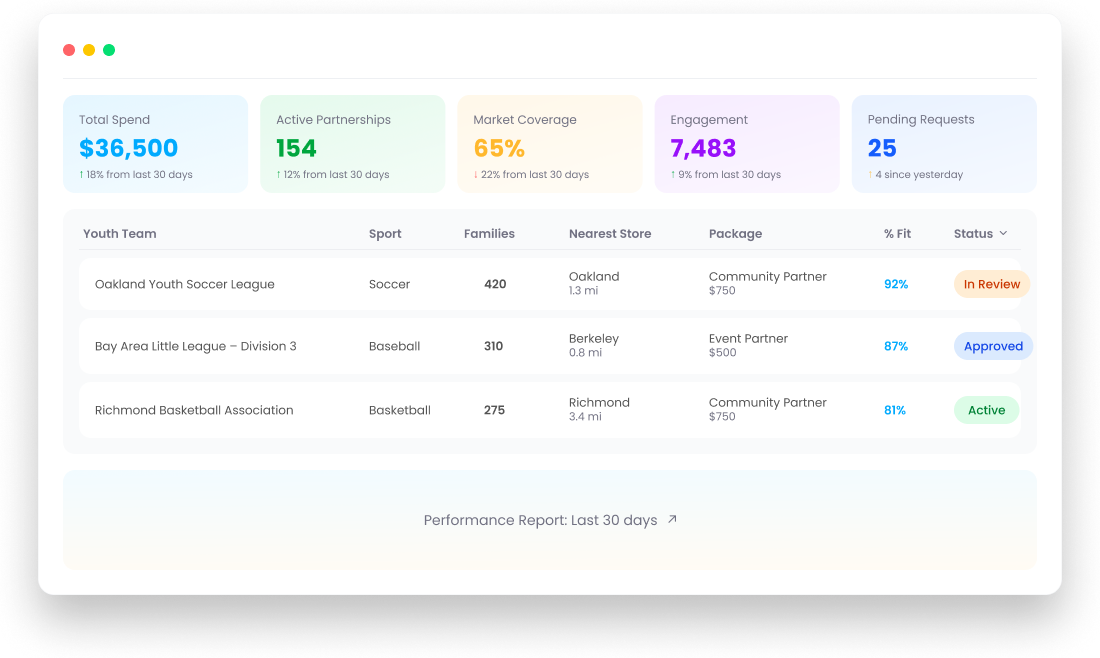
One place for every request. However a sponsorship request arrives (email, web form, walk-in, phone) it enters Sponsa's unified queue. Nothing gets lost. Nothing gets handled off-system. Corporate and location teams work from the same view.
Proactive discovery. Sponsa doesn't just wait for teams to come to you. The platform surfaces relevant local teams in your target geographies that your brand isn't yet partnered with, and initiates outreach on your behalf. You're building the partnership portfolio, not just fielding inbound.
Standardized packages and guardrails. Brands set their terms once. Teams apply and choose from defined sponsorship tiers: what's included, what it costs, what's expected in return. No more custom one-off asks. No more per-location improvisation. Your standards are built into the system.
Activation and fulfillment. Approval is just the beginning. Sponsa handles what comes after: branded social content templates teams can activate, physical collateral that ships directly to the location, and QR codes tied to each partnership for attribution tracking. Activation becomes a process, not an afterthought.
Reporting and visibility. Every active partnership, across every location, in one dashboard. Spend, activation status, and performance data aggregated at the brand level. When leadership asks what community sponsorships produced this year, there's an actual answer.
Without Sponsa and With
The shift isn't subtle. Below is a side-by-side look at what sponsorship management typically looks like today versus what it looks like running through Sponsa.
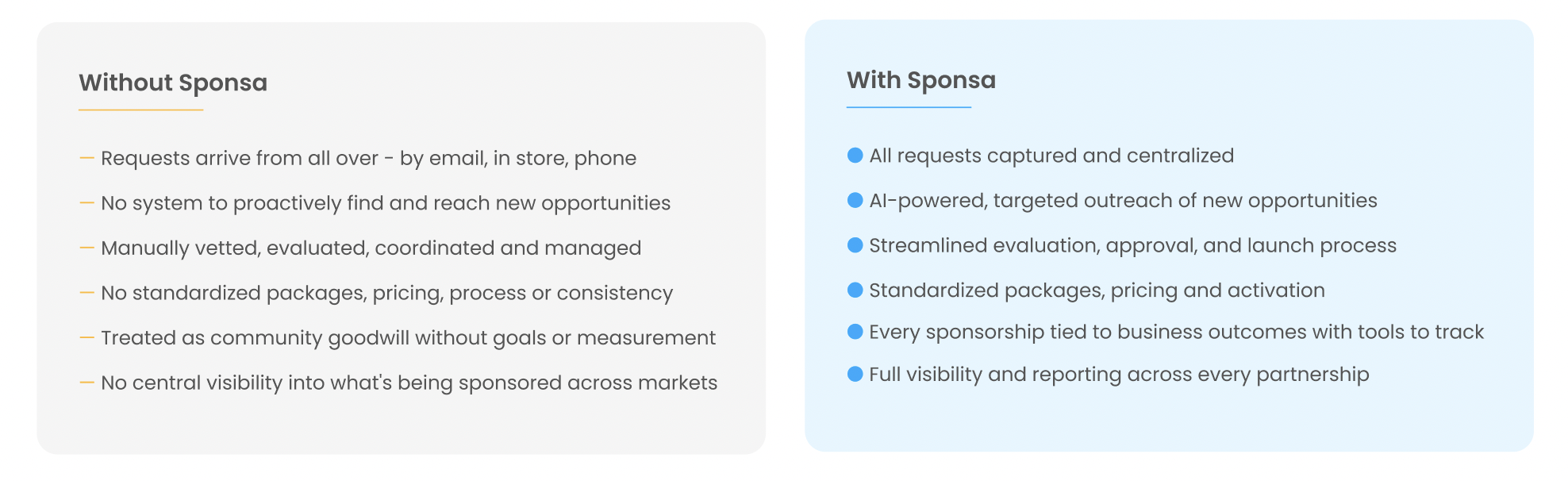
The difference isn't just operational. When every request is captured, every commitment is tracked, and every activation is tied to a measurable offer, sponsorships stop being a line item nobody can explain and start behaving like a real marketing channel. The visibility alone changes how leadership thinks about the category. And when you can see what's working across locations, you can start scaling what works and cutting what doesn't. That's what turns community spend into community growth.
Community Spend Deserves Real Infrastructure
Local community partnerships are not a donation budget or simply goodwill alone. They're a strategic local marketing channel, one that reaches family-dense, hyperlocal audiences with a level of trust that paid media rarely achieves. But like any channel, they only produce results when they're run with intention and structure.
The brands that figure this out first will have a real advantage. Not because they're spending more, but because they're finally able to see what the spend is doing.
Community partnerships are already happening across your locations. The only question is whether you're running them or they're running you.
See Sponsa in action. Book a demo at Sponsa.ai.